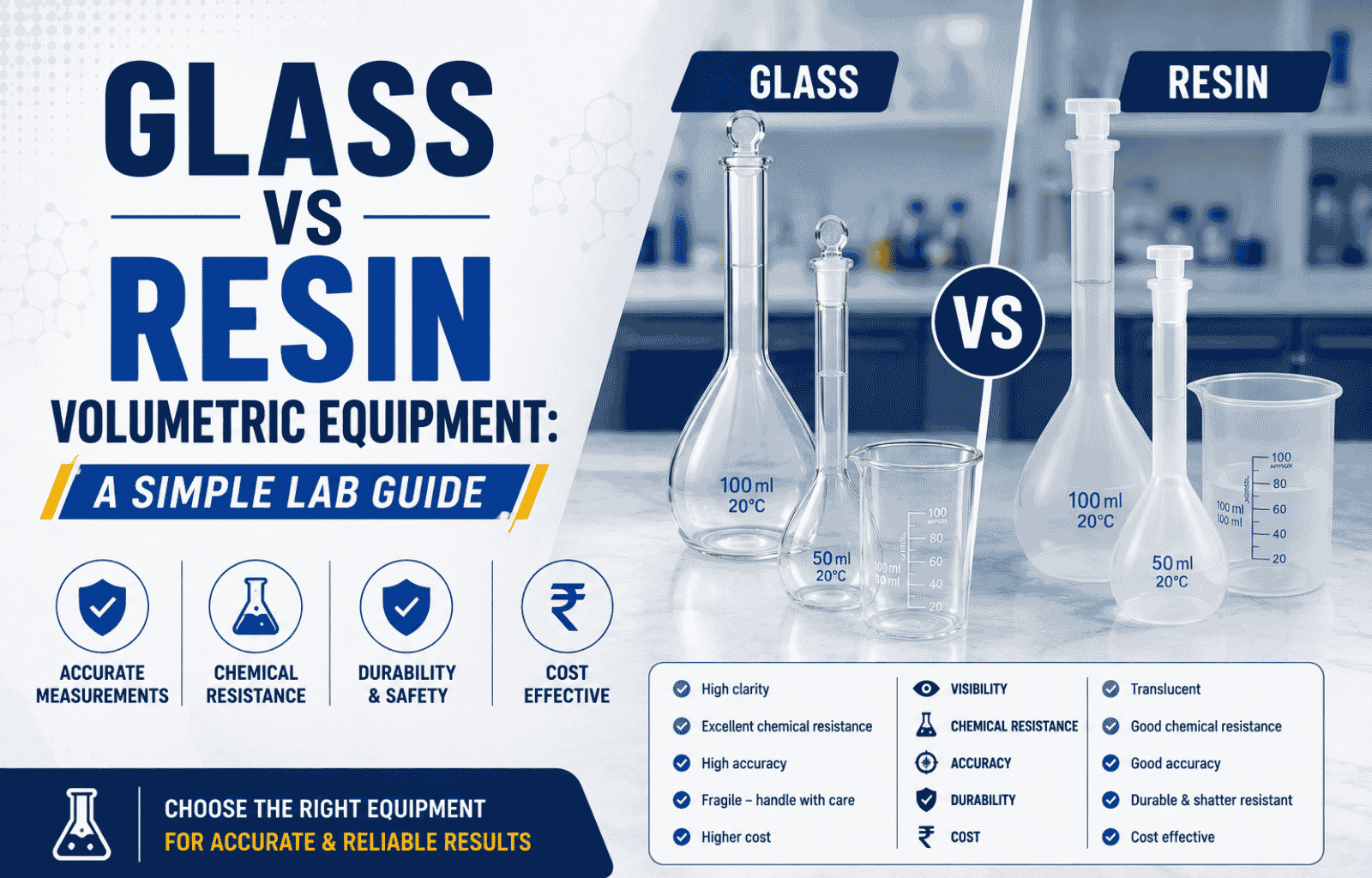
Volumetric equipment measures, holds, or delivers liquids at a set accuracy. Glass tools (borosilicate 3.3) offer top precision and chemical resistance for analytical work. Resin tools (PP, PMP, PTFE) are shatterproof, lightweight, and better for corrosives like hydrofluoric acid. Choose based on accuracy class, chemical type, and use.
Every reliable lab result starts with an accurate measurement. If your volume is off, your whole experiment is off. That is why volumetric equipment matters so much.
This guide explains the two main material types you will meet in any lab: glass and resin (plastic). You will learn the key equipment types, how accuracy classes work, and how to pick the right tool for your work. You will also get clear best practices for cleaning, calibration, and storage.
Featured Products
Whether you run a pharmaceutical QC lab, a research centre, or a teaching classroom, this guide will help you make smart, defensible choices. Let's get into it.
What is volumetric equipment and why does it matter?
Volumetric equipment is glassware or plasticware built to measure liquid volume with a known accuracy. Unlike a general beaker, each piece is calibrated so the marked volume matches the true volume within set limits.
The accuracy of these tools directly affects your data. In pharmaceutical assays, environmental testing, and research, a small volume error can invalidate a result. In regulated labs, using the wrong accuracy class can even fail an audit.
Two things drive your choice: the material (glass or resin) and the accuracy class (A, AS, or B). Get both right, and your results stay trustworthy. For a full range of precision lab tools, browse the laboratory equipment catalogue at dktooling.in.
What are the main types of glass volumetric equipment?
Glass remains the gold standard for precise measurement. Most quality glassware is made from borosilicate glass 3.3, which resists heat and chemicals well. This keeps its accuracy over a long working life.
Here are the core types you will use.
Volumetric flasks
Volumetric flasks hold one exact volume up to a single marked line. They are "To Contain" (TC) items, used to prepare standard solutions and dilutions.
Common sizes run from 10 mL up to 1000 mL. A 100 mL Class A flask has a tolerance of just ±0.10 mL. That level of precision makes them essential for analytical chemistry.
Graduated cylinders
Graduated cylinders measure variable volumes along a printed scale. They are less precise than flasks but faster for routine work. A 100 mL Class A cylinder carries a tolerance of ±0.50 mL, calibrated to ISO 4788.
Burettes
Burettes deliver precise, variable volumes drop by drop. They are the key tool for titrations. A 50 mL Class A burette has a tolerance of ±0.050 mL and follows ISO 385.
Some burettes use Schellbach stripes to make the meniscus easier to read. You can find quality burettes and titration glassware at dktooling.in.
Pipettes
Pipettes transfer set volumes of liquid. There are three main kinds:
- Volumetric (bulb) pipettes: deliver one fixed volume with high accuracy.
- Graduated pipettes: measure several volumes along a scale.
- Micropipettes: handle very small volumes in microlitres.

A 10 mL Class A one-mark pipette has a tolerance of ±0.020 mL. Pipettes are "To Deliver" (TD) items, so drainage is built into the calibration.
Glass tolerance comparison table
The table below shows ISO tolerances for common glass items. Note that Class B tolerances are exactly double those of Class A.
| Item | Volume | Class A (±mL) | Class B (±mL) |
|---|---|---|---|
| Volumetric flask | 25 mL | 0.030 | 0.060 |
| Volumetric flask | 100 mL | 0.100 | 0.200 |
| Volumetric flask | 1000 mL | 0.300 | 0.600 |
| Burette | 50 mL | 0.050 | 0.100 |
| Graduated cylinder | 100 mL | 0.500 | 1.000 |
| One-mark pipette | 10 mL | 0.020 | 0.040 |
What do the accuracy classes A, AS, and B mean?
Accuracy class tells you how tight the tolerance is. It is set by bodies like ISO, ASTM, and DIN, all measured at a reference temperature of 20°C.
Here is a simple breakdown:
- Class A: the highest precision. Used for analytical work, pharma QC, and calibration standards. Can come with a batch or individual certificate.
- Class B: tolerances are about double Class A. Great value for teaching and general reagent prep.
- Class AS: same accuracy as Class A, but with a faster delivery time. Common in burettes and pipettes for repetitive work.
A common myth is that Class AS is more accurate than Class A. It is not. The "S" stands for speed, not extra precision.
What are the types of resin volumetric equipment?
Resin (plastic) volumetric equipment has grown popular as lab needs change. It is made from polymers chosen for strength, weight, and chemical resistance.
The main advantage is durability. Resin tools do not shatter, so they suit fieldwork, mobile sampling, and teaching labs. They are also light, which makes them easy to carry and handle.
Common resin materials
Different plastics suit different jobs. Here is a quick guide.
| Material | Max temperature | Autoclavable | Best for |
|---|---|---|---|
| Polypropylene (PP) | 135°C | Yes | Acids, bases, ketones; general use |
| Polymethylpentene (PMP/TPX) | 120°C | Yes | Clear flasks, cylinders, beakers |
| HDPE | 120°C | No | Bottles, containers; acids and alkalis |
| PTFE (Teflon) | Very high | Yes | Hydrofluoric acid and strong corrosives |
PMP is a favourite for clear volumetric flasks and cylinders because it stays see-through. PTFE stands out because it handles hydrofluoric acid, which glass cannot.
Where resin has limits
Resin is not perfect. Plastic expands and contracts more with heat, which can affect volume accuracy. Some plastics also swell or degrade in organic solvents like acetone or chloroform. Over time, plastic can scratch and lose readability.
Explore shatterproof plasticware and resin lab tools at dktooling.in for field and teaching needs.
How do you choose the right volumetric equipment?
The right choice depends on your task, your chemicals, and your accuracy needs. Ask yourself four questions.
1. How precise must the measurement be?
If the volume feeds directly into a reported result, use Class A. If it is a wash or rough prep step, Class B is fine.
2. What chemicals will you handle?
For most acids, bases, and organic solvents, glass is safe. For hydrofluoric acid or strong corrosives, choose PTFE resin. For fieldwork, resin resists breakage.
3. What does your industry require?
Pharmacopoeias like USP and EP demand Class A glassware for official assays. Always check your protocol first.
4. What is your budget and workload?
Class B and resin cost less and suit high-volume teaching labs. Class A glass is the long-term choice for critical accuracy.
Quick selection guide
| Application | Best choice | Why |
|---|---|---|
| Pharmaceutical assay (USP/EP) | Class A glass | Regulatory requirement |
| Teaching lab practicals | Class B glass or resin | Cost-effective and durable |
| Handling hydrofluoric acid | PTFE resin | Glass cannot resist it |
| Field sampling | Resin | Shatterproof and light |
| Preparing HPLC mobile phases | Class A glass | Accuracy affects results |
| General reagent prep | Class B glass | Rough volumes acceptable |
How should you maintain and calibrate volumetric equipment?
Good care keeps your tools accurate and extends their life. Follow these best practices.
Cleaning and storage
Clean glassware right after use, before residue dries. Use a low-temperature bath with a mild, low-alkaline cleaner. Avoid abrasive scrubbing, which scratches the surface and harms accuracy.
You can dry glassware at up to 250°C and autoclave it if needed. Store items safely to prevent knocks, cracks, and sudden temperature shocks.
Calibration schedules
Calibration checks that the marked volume is still correct. It is verified gravimetrically, using distilled water weighed at 20°C. This process follows ISO 4787.
You do not need to recalibrate often. Age and storage do not change accuracy. But you should recalibrate if:
- Borosilicate glass has been in heavy use for 10 years.
- The item faced temperatures above 150°C.
- It was used often with strong acids or bases.
- You see frosting or etching on the inner surface.
When to retire a piece
Some damage cannot be fixed. Retire any item that shows:
- Star cracks or chips.
- Etched or faded graduation lines.
- Frosted, corroded inner surfaces.
Damaged glassware no longer meets its rated tolerance, even if it once carried a Class A mark.
Documentation for compliance
In regulated labs, keep records for every measuring tool. Store certificates of conformance for Class A items. These state the standard, volume, and tolerance. This paper trail protects you during audits. Source certified glassware with full documentation from dktooling.in.
Frequently asked questions
Is glass or resin volumetric equipment more accurate?
Glass is more accurate. Borosilicate glass is stable and holds its calibrated volume over time. Resin expands and contracts more with heat, which reduces volume accuracy. Use glass for precise analytical work and resin where durability or corrosion resistance matters more.
Can Class B glassware be used in pharmaceutical labs?
Generally, no—not for assay-critical steps. Pharmacopoeias such as USP and EP require Class A glassware for standard solutions and official assays. Class B may be used for non-critical tasks like wash solutions, but never for a measurement that feeds a reported result.
What is the difference between TC and TD glassware?
"TC" means "To Contain." The item holds the stated volume inside it. Volumetric flasks are TC items. "TD" means "To Deliver." The item releases the stated volume when drained. Pipettes and burettes are TD items, and their calibration accounts for the liquid that clings to the walls.
Which resin is best for hydrofluoric acid?
PTFE, often called Teflon, is best. It is highly inert and resists strong corrosives, including hydrofluoric acid. Glass cannot handle hydrofluoric acid because the acid attacks and etches the glass surface.
How often should volumetric glassware be recalibrated?
Not often under normal use. Recalibrate borosilicate glass after about 10 years of regular use. Recalibrate sooner if it faced temperatures above 150°C, was used often with strong acids or bases, or shows any frosting or etching inside.
Is Class AS more accurate than Class A?
No. Class AS has the exact same tolerances and accuracy as Class A. The only difference is delivery speed—the "S" stands for speed. Class AS burettes and pipettes drain faster, which helps with repetitive work.
Choosing wisely protects your data
Your results are only as good as your measurements. Quality volumetric equipment is not an expense—it is an investment in reliable, defensible data.
Match the material to your chemicals. Match the accuracy class to your task. Then care for your tools with proper cleaning, calibration, and record-keeping. Do this, and your lab will stay accurate and audit-ready for years.
Ready to equip your lab? Explore the full range of glass and resin volumetric equipment at dktooling.in and build a setup you can trust.